

SLYP AI
In developmentYour NHS pay, tax and pension — connected.
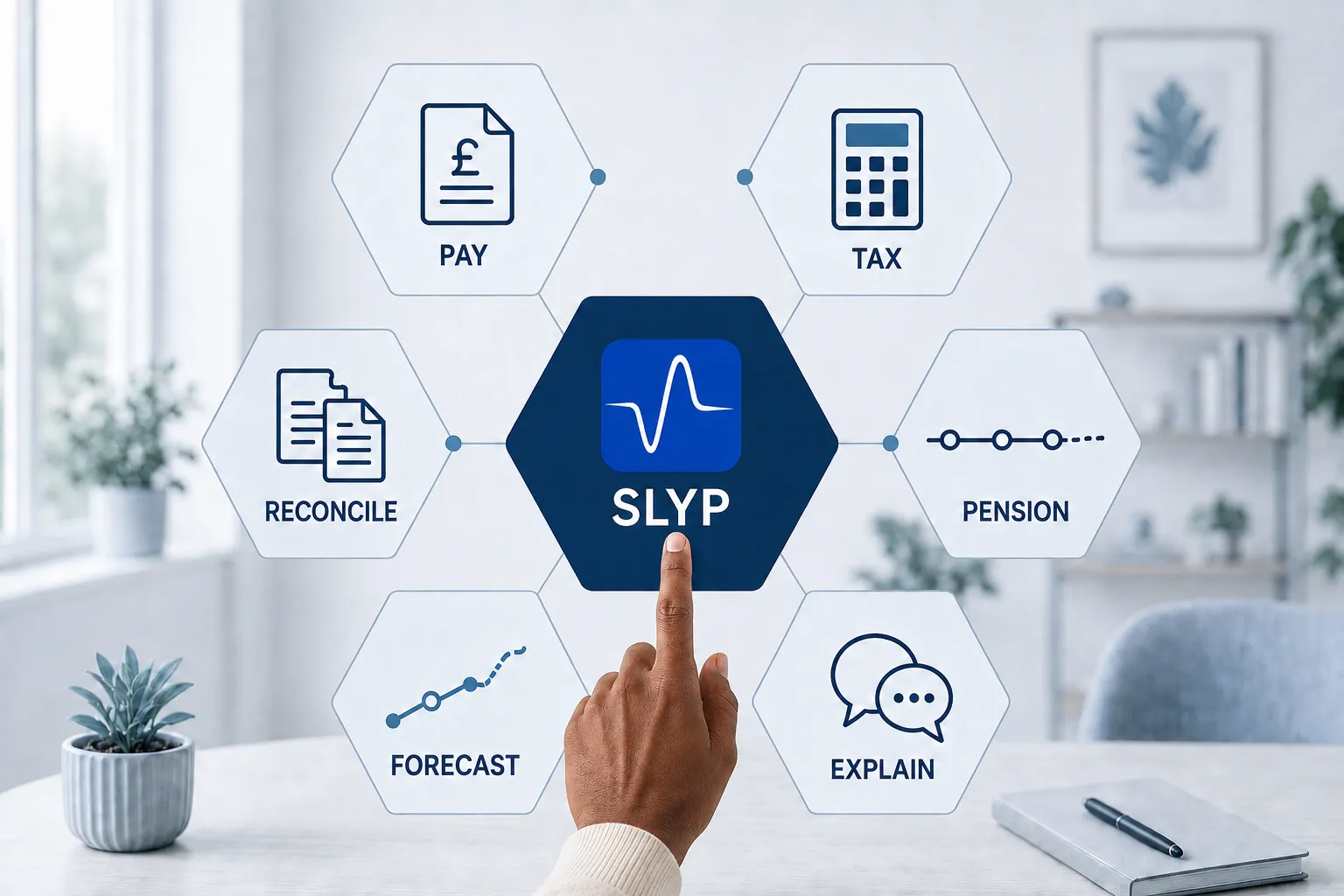
SLYP AI brings together the story behind NHS pay, tax and pensions. Its purpose is to turn separate records into a financial history people can understand: how earnings and deductions connect, where figures differ, and what needs a closer look.
A product of AyVex Ltd
Context
The problem
Employment information for NHS staff arrives in fragments. Pay is recorded on monthly payslips, tax is reconciled through HMRC, and pension membership is recorded separately again. Each record uses its own terms, its own format and its own timing.
Moving between employers, taking on bank or locum work, and changes in pay can make the picture harder to follow. How much did I earn across the year? Why did my take-home pay change? Do my records agree? What do my pension statements mean? These are connected questions, but the information usually sits apart.
Purpose
The bigger picture
The vision for SLYP is an accumulating financial history: a connected view of earnings, deductions, employment changes and pension records that becomes more useful over time. Document reading is the starting point. Reconciliation, explanation and an understandable view across tax years are the purpose.
That means helping people follow a figure back to its source, understand differences between records, and see where information is missing or uncertain. Plain-language explanations should make NHS pay, tax and pension concepts easier to navigate without hiding the detail.
Workflow
From records to understanding
This is the intended end-to-end product journey. SLYP is in development; these stages describe its direction, not a list of fully released capabilities.
Scan
Read supported documents and identify information that needs review.
Understand
Each document is classified and its fields identified — employer, period, pay elements, deductions, codes and references.
Store
Extracted values are held as a structured record against the correct pay period and tax year.
Reconcile
Figures are compared across documents and periods, so gaps, duplicates and inconsistencies surface rather than pass unnoticed.
Calculate
Totals and derived figures are produced by explicit rules for the relevant tax year.
Forecast
Planned scenario tools will explore how changes in earnings and circumstances could affect the picture. Estimates must remain distinct from official figures.
Explain
Each result is presented with the record and the reasoning behind it, in plain language.
Approach
How it is built
The design principle is simple: AI reads documents, code performs calculations, official sources provide checks, and SLYP explains the result and its uncertainty.
AI where reading is the hard part
Automated document reading, classification and extraction handle the variation found in real records — different employers, formats, layouts and eras.
Deterministic where accuracy is the hard part
Calculations and validation are carried out by explicit, testable software rules, not generated by a language model.
Rules tied to their period
Thresholds, rates and allowances change between tax years, so the rules applied are versioned and matched to the period being calculated.
Traceable to the source document
Every figure stays linked to the record it was drawn from, so any result can be checked against the original document.
Records
Records SLYP may work with
SLYP is designed around the documents NHS staff already receive and retain.
- Payslips
- P45
- P60
- HMRC documents
- TRS and ABS related records, where supported
Supported record types depend on the format and availability of the documents a person holds.
SLYP AI
Explore SLYP AI.
The product itself, including how to get started and its own security and privacy information, lives on the SLYP AI website.
Important information
- SLYP AI is a product of AyVex Ltd. It is not endorsed by, approved by, or affiliated with the NHS or HM Revenue & Customs.
- AyVex Ltd is not authorised or regulated by the Financial Conduct Authority. SLYP does not provide financial, tax or pension advice.
- SLYP organises and explains information from the records provided to it. It does not produce official NHS pension calculations, and it does not guarantee the accuracy or completeness of any figure or any particular tax outcome.